The .org TLD is on the one hand highly successful, with its registrant base of 2.6 million and a fourth position worldwide. On the other hand it has not yet succeeded in establishing for itself the unique profile that would enable it to both gain long-term registrant loyalty and enter into constructive dialogue regarding the potential for and viability of services specifically for civil society in its broadest sense.
Our strategy will be to continue to serve the current registrant base while focusing future efforts to extend this base primarily to the non-profit sector, in particular outside the USA.
This strategy builds upon the following observations:
- Diversity: The non-profit sector is itself highly diverse. There is thus no reason to divest the TLD of registrants with a different profile, who can continue to be served efficiently even though they are not prime candidates for new services
- Global balance: The current bias in favour of US-based organizations is reasonable in a historical context, since US non-profits were pioneers of internet use, but large proportion of potential registrants outside the US, and across the digital divide, is as yet unexplored.
- Enabling vs Marketing: Although terms such as “marketing”, “client” and “targetting” are consistent with the business model for the .COM and .NET domains, they carry a for-profit connotation which can be quite alien to the operating strategies of many non-profit bodies. It is indeed the case that “nonprofit marketing” is an emerging discipline, especially appropriate to trade and professional associations and their professionalization in North America. However it is important to recognize that some segments of “civil society”, in its broadest, sense are viscerally opposed to such for-profit framing of their initiatives and the ideology that it represents. In any endeavour to sustain a fruitful relationship with the full spectrum of civil society, this bid will therefore focus on “enabling” and “outreach” rather than “marketing”.
The UIA is already engaged in active exploration of how the internet and the web can be introduced and used more effectively by the civil sector, and will pursue this exploration as part of the differentiation of the .org TLD. To do so means working with the registrars, NGO associations, and other elements, to inform, to develop uses and even to monitor advances in specific sub-sectors, which might be useful elsewhere in the non-profit organizational world.
We see a need to balance on the one hand a proactive approach with a sensitivity to the rightful roles of other organizations working in this emerging and complex environment. Concretely, the UIA will work jointly with registrars everywhere to promote the use of .org, while remaining sensitive to local interests. At the same time it will actively explore various enhanced services, which might provide potential support to end users.
New services will doubtless continue to be developed in the IT world on a regular basis and the UIA wishes to make sure that through the distribution system they are made available on the best terms of quality/price to the civil sector constituencies/.org world.
As we embark upon initiatives aimed at repositioning .org and attracting new registrants, our underlying strategy will be to achieve the following:
- Convey clear messages, notably through registrars, that resonate within the non-profit community concerning the impact that enhanced services provided in .org can have on their organizations.
- Leverage UIA’s 100-year legacy of research, advocacy and outreach to non-profits, to reaffirm that the .org TLD is a “natural home” as it most closely represents the global interests of the non-profit community, and could therefore be considered as a valuable option for any online presence that they establish.
- Utilize the information contained in the UIA registry on the profiles of not-for-profit entities (and later supplemented with primary research), in order to improve understanding of nonprofit constituencies that will respond to the value created in the enhanced services and image present within the new .org.
- Remain sensitive to the needs of international members of the not-for-profit community by showing how .org can be a complement to their organizations online presence without undermining any localization efforts being executed using ccTLDs.
Marketing to nonprofits, or by them, tends to require a “soft-sell” approach rather than the kind of “hard-sell” more acceptable to commercial transactions – if the relationship with, and between bodies in that community, is to be enhanced and new services are to be welcomed
The UIA Team sees its distinctive contribution as being one of enabling initiatives rather than undermining existing service initiatives and in some way locking them out of their possibility to offer web services. Associated with this is the desire to avoid undermining coalitions that have struggled into being at one level in order to privilege coalitions emerging at another.
In the light of the above, the marketing approach to be undertaken is distinguished in terms of the following components:
- Enhancing competition between registrars, notably to reduce prices and enhance quality of service (as explicitly required by ICANN)
- Provision of enhanced registry services:
- designed to enable self-organization, coalition and partnership formation, and contacts between bodies with matching interests
- designed to minimize destabilization of equivalent services operated with scarce resources, and much dedication, by nonprofit bodies
- Marketing of the registry as a strategic opportunity for nonprofit organizations:
- Branding of the registry as a multi-dimensional community space, for example through appropriate imagery (such as suggested by tensegrity structures or Netmap) inviting comment from the .org community
- Opening up subdomains in response to demand to enhance the coherence of subcommunities within that domain (eg .int.org, .ngo.org, .igo.org)
- Marketing to registrars, and in support of them
- Marketing of verification and authentication facilities
- Assisting existing suppliers of web services:
- in relation to the .ORG domain
- in relation to the ccTLD domains equivalents to .ORG
- Elaborating a socially responsible inclusive marketing and branding of enabling services that avoids replicating, and exacerbating electronically, the destructive dynamics evident in non-computer mediated communication:
- Beyond the .ORG domain to the wider nonprofit community, minimizing “come home” and “right of return” strategies liable to undermine other domains or subdomains, notably at the country level, that would be destructive of other efforts at community building and enhancement of national identity, especially in smaller states and developing countries
- Across the sectoral divides of the nonprofit community, recognizing that some bodies may not perceive, or wish to perceive, themselves as identified closely with a larger community defined however democratically by any self-selected dominant group claiming – in the light of its own agenda – to operate in the best interests of others whose collective identity and operating styles may be undermined by this process
- Beyond the digital divide to bodies that may consider or seek some form of direct or indirect electronic presence (often with the most restricted resources), recognizing that in offering them services and strategic guidelines this should be done so as to support them in their choice of domain and services, notably with respect to their national or other identity, by responsible presentation of subdomain and ccTLD options.
- Across the distinctive operating styles that characterize and segment the nonprofit community, recognizing that some welcome unsolicited offers of services (and dissemination of their profile to that end), whereas others experience it as totally invasive, inappropriate and a drain on their capacity to handle information overload
- Across the cultural divides and their visible linguistic and presentation manifestations, recognizing that communication in a dominant language or use of a dominant design style, may be precisely what is most inhibiting and erosive of the healthy development of some parts of the nonprofit community
- Across the non-profit/for-profit divide in order to encourage partnerships and hybrids where these are mutually beneficial and to minimize aggressive marketing of services to non-profits and the transformation of the image of the non-profit community into a “market” (notably by the operator of the .ORG domain)
- Across the governmental/nongovernmental divide, especially in cases where political tension and differences are very strong (eg “free-trade” vs “anti-globalization”), whilst seeking to enable partnerships where these are mutually beneficial
- Across the public/private divide, especially with respect to intellectual property and privacy issues, notably in relation to electronic surveillance and management of controversial content
- Across the global/local divide and its regional variants, whether to enable vigorous local expression (to restrain its suffocation and distortion within dominant global fora) or to encourage the emergence of global coalitions to provide bridges between fragmented local or national initiatives
- Across the competition/collaboration divide that, under some circumstances characterizes the vigour of the nonprofit community at its most admirable, but which may also inhibit the emergence of fruitful coalitions and partnerships in support of coherent strategy, thus exacerbating duplication of effort and competition for very scarce resources
- Across the large/small divide to enable smaller bodies to determine a mode of operating and using services to function effectively according to their own criteria (including “small is beautiful”) within the larger context of the nonprofit community and its many powerful coalitions, without inhibiting their own freedom of expression or their emergent sense of identity
- Across the “advocacy” / “celebration” divide that distinguishes those with a strong, possibly activist, agenda (for which they seek the support of others by exploiting internet services) from those pursuing a particular interest or activity with their peers (and relatively indifferent to the support or interest of others from whose communications they may even desire a measure of protection)
- Across the “specialist” / “generalist” divide, characterized by the challenge of providing web services to facilitate interdisciplinary communication between highly structured technical jargons (and the associated peer group identities) and their comprehension by generalists, recognizing the potential for exacerbating tendencies towards closed elitist patterns of communication and perception of mutual irrelevance
- Researching and indicating possibilities for new web services in the light of advances in technology, the recognition of need and the response to feedback and requests
Integral to the “marketing” strategy therefore, will be an effort to elaborate, through a consultative process, a code of conduct guiding consideration of services and their provision for the .ORG community and its ccTLD equivalents.
Fostering differentiation
The most critical element for a campaign intended to differentiate the .org TLD is in repositioning the TLD in the mind of prospective registrants. To achieve this differentiation, Diversitas will seek ways to undertake several functional initiatives in order to enable all concerned to frame new images of .org within the non-profit community. Functional initiatives are an important component that should be embedded within any effective, proactive strategy to re-establish a public image of .org as a “natural” community – albeit with highly diverse membership. Indeed, it may be the diversity itself, which is the outstanding hallmark of the .org community.
The following represents highlights of tactics that would be explored to differentiate .org if UIA / Diversitas were awarded the contract to provide registry services.
- Research: Conduct primary research on the not-for-profit community to improve insights that can be drawn from the profile data contained in the UIA registry.
- Segmentation: Identify constituencies within the non-profit space that may be benefit from communications and services based on specific value propositions.
- Image-building: Fundamental to the challenge of differentiation is to enable new approaches to image-building within the nonprofit community as a support for a sense of community identity and to sustain new patterns of collaboration.
- Positioning: Enable all concerned to use creative resources, including professional agencies, to help develop distinctive new identities for .org that dissociates it from its U.S.-centric past.
- Enhanced services: Utilize enhanced services, such as authentication technology, to distinguish constituencies of interacting non-profits from commercial entities within the .org TLD.
These points are explored in the following sections.
Research: Learn What the Not-for-Profit Community Wants from the TLD
Diversitas recognizes the challenge of enabling those concerned to reposition the .org TLD with respect to the civil society sector in its broadest sense. It recognizes the need to gain greater insight into determining the key benefits that this community requires/expects from the .org TLD. It is recognized that determining these benefits requires a thorough understanding of the different constituencies of registrants, their respective decision-making processes, cues to which they may respond, and their preferred modes of interaction (if any) with Diversitas, registrars, portals and other intermediaries. In order to acquire this understanding, Diversitas plans to conduct primary research across the not-for-profit sector to obtain their answers to questions such as:
- Qualities: What are the primary attributes you would like to see within .org that would motivate your organization to register a domain name within that TLD?
- Services: What new services would have the greatest impact on their decision to register a .org domain name?
- Alternatives: What are some features/attributes in other TLDs that have prompted some members of the not-for-profit community to register domain names ending with extensions other than .org, if not for the purposes of greater localisation?
The UIA / Diversitas has an excellent basis for conducting such research in that it maintains profiles of around 50,000 international non-profit bodies, and some nationally focused bodies that may be considered part of that community. Additionally, UIA has been conducting research within the non-profit organizations market for nearly 100 years. To the extent appropriate with a sector highly averse to invasive research, Diversitas intends to enable surveys across the civil sector, and build upon some of the following facts concerning those organizations that currently have a domain name:
- They are all represented or have activities in more than one country – some in more than 100 countries.
- Most of them have significant international communications activities. The bodies in this international community have been moving rapidly across the digital divide since the establishment of the web, as information technology became accessible. Such technology is vital to their ability to communicate with their members at reasonable cost. Of 30,000 such bodies, some 23,000 (or 77%) now have URLs.
- National non-profits (outside the U.S.) have similar needs but are even less likely to have chosen to use the .org TLD. In other respects, the internationals may give a good indication of the market potential and challenge posed by the nationals
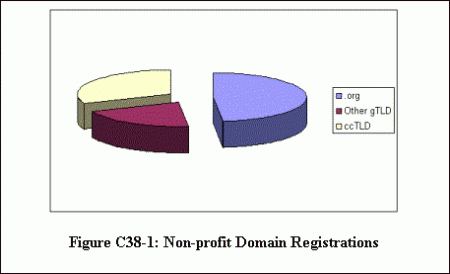
- International bodies may well be hosted by national organizations (notably using ccTLDs), or within a complex web site, and of more than 20,000 that were examined, only 48% had registered a domain name ending with .org, while another 52% had done so using either another gTLD or a ccTLD. (see Figure C38-1)
Segmentation of .org “Community” -- and healing imagery
At the heart of the Diversitas strategy is the goal of offering .org as a natural choice for all categories of non-commercial groups by enabling the emergence of any improved degree of sense of shared identity, or community, that is considered appropriate by different constituencies – recognizing that many so registered do so in order to express an alternative sense of identity. This strategy implies a radical shift from a “registry” mindset to a “community” mindset.
“Community” is an easy word to use. In practice, however, it has multiple meanings and associations. For some it is perfectly adequate as a loose term to apply to a pattern of undefined associations that individuals and groups activate and enhance through “networking”. The telephone system and e-mail are ideal technologies to support community. Services to the .org community can indeed limit themselves to focusing on web equivalents.
The notion of “community” by its very nature tends to focus on, and assume, a degree of consensus. It ignores the basic fact that for many bodies in .org their main concern is to counteract and oppose the initiatives of other bodies in that same domain. Such opposition may be basic to their sense of distinct identity and the prime reason for their distinct existence and expression on the web. There may indeed be a recognition of shared membership in community in the most abstract sense, and shared interest with regard to freedom of expression, but the lack of consensus across sectors and ideologies is a fundamental issue in responding to the realities of the dynamics within that “community”. In confronting the realities of these dynamics, the challenge will be to respond creatively to the variety of “divides” (as noted earlier) that fragment the community of non-profit bodies, including especially :
- The digital divide
- The cultural divide between the dominant western style, and its association with elites in many developing countries, and the variety of alternative styles, the sectoral divide, and the styles of thinking and activity associated with each the linguistic
The challenge is also to give meaningful expression to this more ecological sense of community. The .org community is not only about agreement, but also about the disagreements that are fundamental to the vitality of democratic society. It is unacceptable to develop a marketing strategy based on the assumption that the .org community is composed of those who agree with a set of principles selected by a particular coalition – and that all who do not agree with them should be encouraged to move elsewhere. The .org community is not homogenous. It might be better understood as made up of “communities” with different identities and operating mindsets – often valiantly struggling to sustain their uniqueness and resist its dilution by other cultural forces.
In this sense, the image of the .org community that could be realistically promoted would indicate both:
- Links of commonality binding elements of the community together
- Links of opposition holding elements of the community apart
Image-building
Implicit in many of the above strategic elements are social challenges that face-to-face communication has not yet resolved between sectors of society, notably in the case of:
- belief systems and their agendas (whether ideological or religious),
- inter-organization political processes, and
- lifestyle and cultural preferences.
It will not be assumed, as part of the marketing and branding initiative, or the provision of any web services, that these societal issues will be readily resolved and “magicked away” through computer-mediated communication. Imposition of any one creative dialogue model is not a feature of the strategy advocated. There are many such models – and their number and the fervour of their respective advocates has only served to exemplify the problem of the failure of such models to resolve the bloodiest real-world conflicts. Nor will it be assumed that, deliberately or inadvertently, efforts may be made to replicate such dynamics in the electronic context to the advantage of some and to the disadvantage of many.
As part of the image-building and branding process for the nonprofit community, and rather than any single model, the UIA Team will therefore engage in an ongoing search for fruitful metaphors to enhance understanding of that community. This device will also be used to guard against less fruitful framings of that community. In the spirit of the internet classic for the open source community, Eric Raymond’s well-known The Cathedral and the Bazaar, some illustrative metaphors that may help to encapsulate the challenge and the possibilities include:
Cathedral: the facilities of the web do indeed enable the nonprofit community to engage in a collective activity analogous to that of the cathedral builders of the Middle Ages. Coalitions exemplified by patterns of hyperlinks, beyond simple web rings, illustrate the possibility. The challenge is encourage the emergence of services to enable those in the nonprofit community to construct hypermedia environments that provide a framework or scaffolding for the dynamics of that community. They are temples of knowledge or belief.
Bazaar: web services such as eBay exemplify the excitement of the market metaphor as a way of framing web services for the nonprofit community. But in this case it is as much, if not far more, a market of ideas and interests rather than commercial products and services. The market metaphor helps to make the distinction that the UIA Team would seek to avoid hypermarkets in such a way as to destroy the viability of Mom-and-Pop stores and corner-shops. The nonprofit community should not need to fall into the trap that has been so well explored in the destruction of urban communities and jobs in many parts of the world. To a far greater extent, the nonprofit community exemplifies a preference for “small is beautiful” – even though an occasional visit to a mega-store may be appreciated. The UIA Team would encourage a new balance in this respect.
Neighbourhood renewal: A major concern about the .ORG domain is a consequence of its early perception as effectively a dumping ground for “others”. It is no coincidence that this “other” is now defined by negatives: non-commercial, non-profit, non-governmental – if not ineffectual! As with any physical community, some have now expressed the strong desire to “clean up” the .ORG neighbourhood. Others are anxious to keep their property and resent the implications and agendas of those who want to take them to the “cleaners”. The dynamics of this are well known in many neighbourhoods.
Varieties of .org: The development of the .org community has focused to date on ORGanization and there is much merit in the associated imagery. There is however a strong case for considering other complementary images, for example, by using the following play on words:
- ORGanic, nicely recalls that many bodies in the community function together, and thrive, more like an ecosystem than an inorganic building complex typical of commercial or bureaucratic institutions. The nonprofit community is in many ways organic in its growth and development rather than inorganic.
- ORGan, brings in a musical metaphor to contrast with the visual and textual most commonly used to articulate understanding of the nonprofit community. The cathedral metaphor could be enhanced by an understanding of how each body in the community is effectively a key or note in the world’s most awesome musical instrument. The challenge for web services is to enable the organ to tune itself, to play and to encourage the development of new melodies and harmonies that will make peoples hearts sing.
- ORGy, is a reminder of the chaotic enthusiasms, of every conceivable description, with which people engage in the dynamics of the nonprofit community. In Greek mythological terms this is the Dionysian counterpart to the Apollonian emphasis of Organization – although, ironically, it is with .COM that most Dionysian preoccupations are associated.
Varieties of registry: Much is made of the registry function in relation to .org, but little is said of the “register” itself or the process of registering. In its most common bureaucratic use, “register” has little to do with enhancing the life of a community. It focuses on noting births and deaths, particular rites of passage, or their equivalent with respect to property. It is valued for the exactitude with which it performs this function over very long periods of time. But, as noted earlier, the UIA Team will explore ways of developing what might be understood as a “multi-dimensional” registry. This might however be presented in any image-building campaign through another notion of register, namely in music. For any musical instrument, including the human voice, the register is the range of tones produced in a particular manner. This emphasis on variety, associated with the ORGan image, offers a new way of framing the registry function in any image-building campaign. It recalls current efforts to detect and comprehend significance in very large data sets using auditory display (or sonification) which are the preoccupation of the International Community for Auditory Display – itself part of the .ORG community. It suggests the possibility that the web interactions within the .ORG community (or any part of it), or the traffic monitored by the registry service, might be presented sonically rather than otherwise.
New imagery is required consistent with the idea of contrasting and complementary communities which constitute a larger community The goal would be to provide services that honour such practical lived realities of organizational life and to show how these two complementary forces enable the emergence of a larger, more coherent, superordinate structure beyond the preoccupations of individual organizations and sectors. A key factor in responding creatively to the destructive dynamics that renders coalitions unsustainable would be to enable self-organizing dynamics that use such complementarity to avoid the need for any central organization to hold the community together.
Positioning .org Based on Segmentation
In view of the diversity among not-for-profit organizations, Diversitas intends to utilize its knowledge of segmentation across this space in order to redefine the positioning and imagery now associated with .org. In doing so, Diversitas will leverage feedback from its forums with the non-profit community to create a strong image in support of .org being a natural home for the non-profit “community”, and also address some latent issues that have been previously associated with .org.
Diversitas must convey a message that resolves the relationship between the “registry” mindset and the “community”. The technologies required for a registry to work must necessarily be very narrowly focused on the identification of an entity – and “untainted” by its perceived status in the community. However, this very lack of ambiguity renders the management and effective use of millions of URLs satisfactory to all. Excluded from registry technology is any information that reflects the structure of community. The list structure and dynamics of a registry (like a telephone directory) does not in itself make for community.
Thus positioning of the .org community needs to be considered in the light of the following:
- What is meant by civil society in limiting understanding of the many dimensions of the .org community
- Data indicative of the community of which only .org can be a focus
- How the notion of “community” can be enhanced in relation to .org
- How marketing of .org can be associated with community building and vision
- Issues in image-building: conveying the image, flavour or philosophy of the whole approach
Additionally, Diversitas is careful to address some of the latent issues that have been previously associated with .org.
- “Property” issues:
- Movements in favour of “cleaning up” .org
- Legacy “possession” of .org URLs by some perceived as “undesirable”
- Exclusive marketing strategies, exacerbating unfair competition and undermining initiatives of non-profit bodies in the .org and associated communitie
- Privileging particular suppliers of web services, creating a monopoly situation that inhibits supply of web services by others
- Destabilizing and undermining existing suppliers of web services
- Marketing to the non-profit “diaspora” beyond the .org domain, notably to ccTLD equivalents
- Requiring effective relationships with bodies supporting such domains
- Marketing responsibly to avoid tendencies to undermine national initiatives that may be vital to sustaining cultural identities in emerging countries
- Embodying democratic principles of responsiveness and transparency
- Recognizing the absence of tested models adequate for a global multi-cultural, multi-lingual, multi-sectoral community significantly characterized by divisive dynamics
- Recognizing the natural resistance of independent (“sovereign”) sectoral organizations to conscription into apparent membership of a managed inter-sectoral community
- Ensuring that efforts to embody democratic principles do not undermine the basic registry function