Encyclopedia of World Problems and Human Potential
Edited by the Union of International Associations, Published by K.G. Saur München. 4th edition, 1994-95, 3 vols., ca. 3000 pages, hardcover. ISBN 3-598-11165-7. (The three books are also available as individual volumes.) There is also a CD-Rom edition of the complete Encyclopedia on CD for individual users (please enquire at UIA for site licences). Price / order.
The three volumes are:
- World Problems (see commentaries)
- Human Potential: Transformation and Values (see commentaries)
- Actions -- Strategies -- Solutions (see commentaries)
For an on-line demonstration, see via http://www.uia.org/db/
The Encyclopedia of World Problems and Human Potential is the result of an ambitious effort, since 1972, to collect and present information on the problems with which humanity perceives itself to be confronted (see overview Description and Commentaries). It aims to clarify the challenges such problems represent to concepts, values and development strategies. The Encyclopedia encourages the discovery of a new conceptual dynamic for understanding and action, sufficiently complex to encompass the factions, conflicts and paradigms by which people are separated - both from each other and from a promising future. For related information see Encyclopedia Project.
In the past, much effort has gone into the focus on seemingly isolated world problems, such as unemployment, boredom, endangered species, desertification or corruption. Work on the newly published Encyclopedia of World Problems and Human Potential has now shifted its focus to the hunt for complex networks and even vicious cycles of problems. A cycle is a chain of problems, with each aggravating the next -- with the last looping back to aggravate the first in the chain. The more obvious loops may be composed of only 3 or 4 problems. Far less obvious are those composed of 7 or more.
An exampleof a vicious cycle is: Alienation -> Youth gangs -> Neighbourhood control by criminals -> Psychological stress of urban environment -> Substance abuse -> Family breakdown -> Alienation. Such cycles are vicious because they are self-sustaining. Identifying them is also no easy matter. Like the search for strange particles in physics, much computer time is required to track through the aggravating chains linking problems. A preliminary search along 9 million such pathways has so far identified 19,000 cycles composed of up to 7 problems -- of which 2,873 are specifically identified on the CD-ROM.
Organizational strategies and programmes that focus on only one problem in the chain tend to fail because the cycle has the capacity to regenerate itself. Worse still is that such cycles tend to interlock, creating the complex of global problems which causes so many to despair. The good news is that identifying vicious cycles is a first step towards designing cycles of strategies to reverse or break them. Better still some problems are linked by serendipitous cycles in which each problem alleviates the next -- and, even better, some strategies function in serendipitous cycles to reinforce each other and break vicious problem cycles. Detecting them is a future focus of the Encyclopedia project.
The sources of information for the Encyclopedia are international organizations and constituencies. By focusing on both problems and strategies, as well as constructive and destructive values, it endeavours to transcend the usual polarization of issues and responses to them.
With a total of nearly 20,000 entries, linked by over 158,000 cross-references (an increase of 44%), the new edition is even more comprehensive than before. Entries themselves have been rigorously updated and extended in both quantity and content. For example, over 90% of the problem descriptions have been revised or updated since the previous edition in 1991. Editorial work for the 1994 edition focused on major updates to world problems and their relationships, to approaches to human development, and to human values and their relationship to world problems.
Both the Encyclopedia and the Yearbook are ongoing programmes of the Union of International Associations. As a nonprofit research institute, founded in Brussels in 1910, it now functions as a clearing house for information on other international nonprofit organizations, whether governmental or nongovernmental.
Volume 1: World Problems (see on-line demo via http://www.uia.org/db/)
4th edition, 1994-95, 1 vol., 1,258 pages, hardcover. ISBN 3-598-11225-4. (Individual volume price : DM 548; US$ 245; £280; BEF 11,500).
The first volume of the 3-volume Encyclopedia (now in its 4th edition) currently describes 12,000 world problems clustered into 320 overlapping hierarchies in 1,200 pages. The problems are linked by some 120,000 relationships of 7 types. Problems included are those identified in international periodicals but especially in the documents of some 20,000 international non- profit organizations (profiled in the companion 3-volume Yearbook of International Organizations, now in its 32nd edition). The Encyclopedia includes problems which such groups choose to perceive and act upon, whether or not their existence is denied by others claiming greater expertise. Indeed such claims and counter-claims figure in many of the problem descriptions in order to reflect the often paralyzing dynamics of international debate. In the light of the interdependence demonstrated among world problems in every sector, emphasis is placed on the need for approaches which are sufficiently complex to encompass the factions, conflicts and rival worldviews that undermine collective initiative towards a promising future.
Problems are grouped into the following sections:
- Basic universal problems (170 )
- Cross-sectoral problems (575)
- Detailed problems (2,162)
- Emanations of other problems (3,857)
- Exceptional problems (3,072)
- Very specific problems (2,153)
- Problems under considferation for inclusion (214)
The number of world problems described is now 9,832, with a further 2,380 referenced by index only. New problems for this edition number 1,675. Considerable effort has been devoted to consolidating and improving previous texts (increased by 33%). Over 70% of problems with incidence have been updated. The number of cross-references between entries has increased by 49% to 119,000.
Volume 2: Human Potential: Transformation and Values (see on-line demo via http://www.uia.org/db/)
4th edition, 1994-95, 1 vol., 928 pages, hardcover. ISBN 3-598-11226-2. (Individual volume price : DM 548; US$ 245; £280; BEF 11,500).
The human potential volume is divided into 5 sections:
- Human development concepts and modes of awareness (4,456 entries linked by 15,237 relationships)
- Integrative concepts
- Metaphors and patterns
- Transformative approaches
- Human values and wisdom (3,254 entries linked by 23,237 relationships)
The number of human development entries has increased by 10% to 4,475, with the cross-references between them increased by 19% to 17,900. The human values section has been adapted and extended in order also to serve as a unique index to world problems from a value perspective.
Human development (see on-line demo via http://www.uia.org/db/) (see commentaries)
The second volume of the Encyclopedia contains the most comprehensive description of the variety of approaches to human development. While their intention may be to alleviate suffering, paradoxically their blinkered pursuit is often a prime cause of world problems, notably in the case of religious conflict. Not only are there some 1,400 understandings of human development from the spiritual and psychological disciplines of different cultures and traditions, but also 3,050 modes of awareness or experience that are reported to be accessible through such disciplines, often through identifiable sequences or pathways. Buddhism offers the most elaborate perspective, requiring 1,360 interlinked entries (which can be explored as hyperlinks). An extensive bibliography is also included.
Integrative concepts
The Encyclopedia programme has included work on interdisciplinary, integrative and unitary concepts since the first edition in 1976. The intention was to present understandings of integration and ways of dealing with the cognitive complexity characteristic of networks of problems, organizations and strategies. Profiles of some 600 such concepts were presented in the 1991 edition. The 1994 edition includes the bibliography (in Volume 2) plus extensive commentary on the challenge of interdisciplinarity and logical discontinuities between disciplinary approaches (in Volume 3).
Metaphors and patterns (see commentaries)
The 1991 edition included examples of some 80 metaphors potentially significant to new and more fruitful understanding of discontinuity and disagreement. In the current edition the focus is placed on extensive commentary on the relevance of metaphor to governance faced with conflicting demands and understandings. Some of the original research material can be reviewed on this site. An extensive bibliography is also included.
Transformative approaches (see commentaries)
Extensive commentary is provided on a range of transformative approaches, from mapping techniques to the relevance of poetry-making to policy-making. <
Human values (see on-line demo via http://www.uia.org/db/) (see commentaries)
The Encyclopedia takes an unusual approach to the range of human values. Rather than limiting its focus to the dozen values most frequently discussed (peace, justice, and the like), Volume 2 identifies 987 "constructive" or positive values as well as 1,990 "destructive" or negative values. The positive and negative values are clustered into 230 value polarities (like beauty- ugliness) to transcend the semantic confusion associated with many value-words. It is however the negative value terms which are used to sharpen the problematic nature of the problem names given in Volume 1. Negative values are systematically cross- referenced to both world problem names and to the complementary positive values (via the polarities). For the first time it becomes possible to trace the positive values in terms of which problems becomes perceptible. Also for the first time, values are cross-referenced to human development where particular approaches or experiences enhance the understanding of a particular value. The editors explore a variety of possibilities of organizing value terms as a prelude to any justification for the current preoccupation with so-called basic values.
Volume 3: Action -- Strategies -- Solutions (see on-line demo via http://www.uia.org/db/) (commentaries)
4th edition, 1994-95, 1 vol., 928 pages, hardcover. ISBN 3-598-11227-0. (Individual volume price : DM 548; US$ 245; £280; BEF 11,500).
The 4th edition of the Encyclopedia has been extended to include a new third volume on international organization action strategies.
Volume 3 of the book contains descriptions of over 15,000 international strategies and action plans (29,000 included in the CD-ROM version). It cross-references the world problems in Volume 1 and the international organizations described in the companion Yearbook of International Organizations
This section profiles strategies currently employed by international bodies, whether in response to world problems or to enhance particular values or modes of development. It also provide the first systematic identification of several thousand vicious problem cycles to which such strategies need to respond. It identifies mutually reinforcing strategic cycles.
Strategies are grouped into the following sections:
- In CD-Rom and book:
- Basic general strategies (158)
- Cross-sectoral strategies (1,100)
- Detailed strategies (3,325)
- Emanations of other strategies (3,008)
- Exceptional fuzzy strategies (1,382)
- Strategy polarities (240)
- In CD-Rom but not in book:
- Very specific strategies (7,685)
- Insufficiently cross-referenced strategies (4,983)
- Uncross-referenced strategies (7,627)
The information on strategies and action plans, developed from a section last included in the 1986 edition, provides the necessary remedial focus to balance the information in Volume 1. It too relies on information provided by international organizations.
The volume also lists a selection of 836 vicious problem loops
Scope and challenge
Although it is still possible to gather and configure so much detail into book form (or onto the CD-ROM version of the Encyclopedia and Yearbook), the editors are much concerned with new ways of visualizing complex networks of relationships. The challenge is to find meaningful ways to navigate through such complexity and to evoke imaginative insights in response to it. In a section on transformative approaches, the editors explore the implications for computer graphics, transformative conferencing and the design of policy cycles capable of responding to vicious problem cycles.
Much emphasis is placed on the potential of new metaphors for governance as a major unexplored resource to enable paradim shifts. The suggestion is made that many institutions and policies are trapped in inadequate policy metaphors. In this spirit the Encyclopedia even contains an extensive exploration of the relevance to governance of fruitful cross-fertilization between poetry-making and policy-making -- seen as equivalent to the mythical challenge of arranging a marriage between Beauty and the Beast.
The Encyclopedia offers radically different perspectives to policy-makers, social researchers and those concerned with development strategy. It is also fascinating reading for any individual with concern for human affairs and wary of the risks of "tunnel vision" in conventional approaches to crises and opportunities.
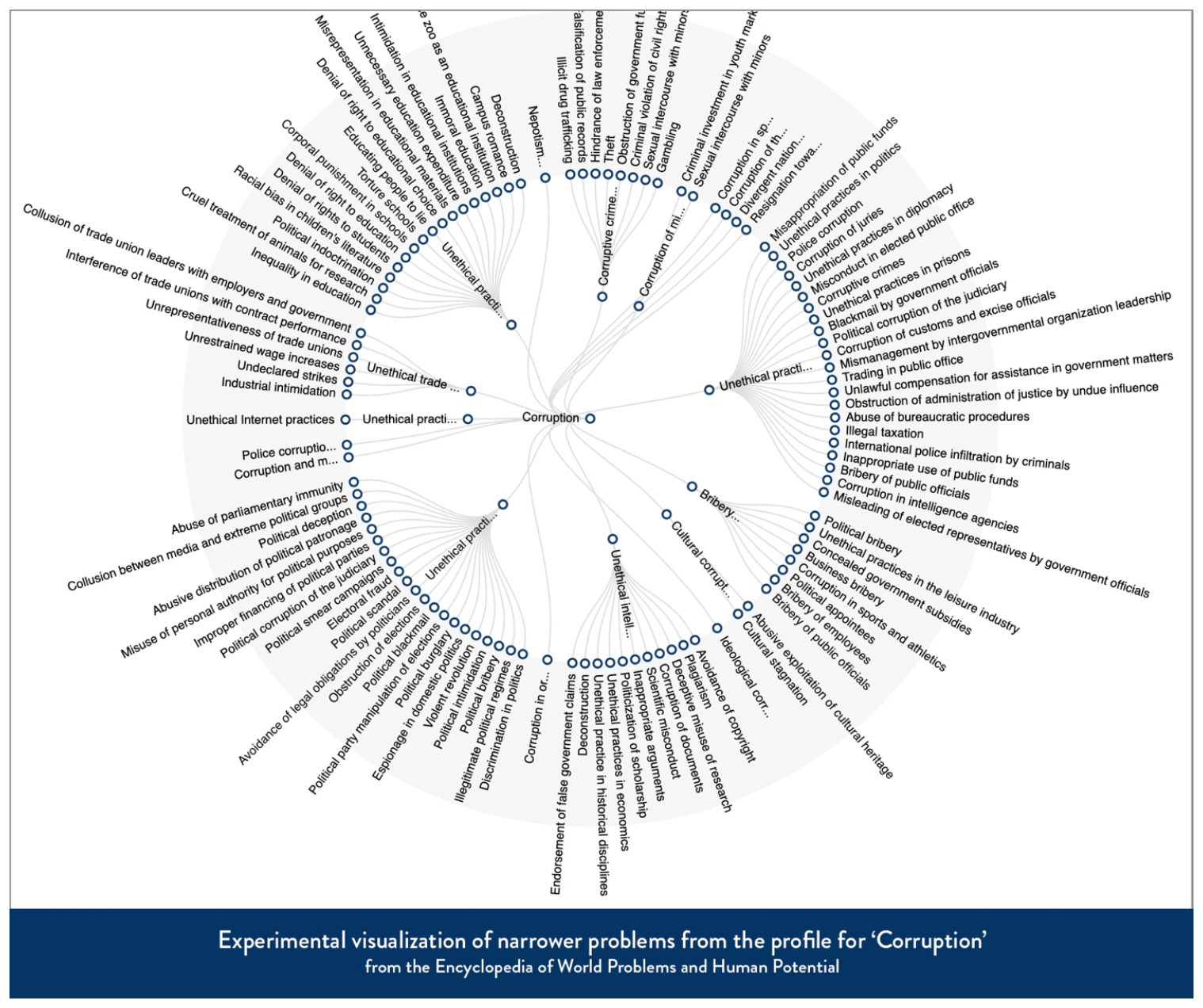
Most encyclopedias focus only on positive, sanitized aspects of society, presenting an idealized worldview that denies the shadow of humanity. This is one of the few even to mention the existence of such phenomena as corruption (96 entries), torture and many others that do not appear on the agendas of international conferences. It attempts to present the world as many experience it, whether negatively or positively.
Users of the Encyclopedia are encouraged to discover new approaches to understanding and action through the deliberate juxtaposition, within the same context, of contradictory perceptions and fundamentally incompatible viewpoints. By juxtaposing different, but complementary, perspectives, the Encyclopedia is deliberately designed to challenge unquestioned patterns of response to the crises of the times and to evoke new insights in the reader. In this sense it is full of shocks and creative surprises.
This unique 3-volume reference book is a comprehensive sourcebook of information on recognized world problems, their interconnections and the human resources available to analyze and ultimately respond to them. Many are seldom, if ever, described elsewhere in specific or precise terms. Much of the information derives from the United Nations and other intergovernmental agencies, as well as from the many international nongovernmental bodies documented in the companion 4-volume Yearbook of International Organizations.
A unique source of information on problems and strategies transcending national boundaries
The Encyclopedia is innovative in that considerable effort has been devoted to identifying and juxtaposing the many conflicting perceptions and priorities which constitute the dynamic reality of world society. Such information is usually difficult to extract from research literature stressing theories, administrative documents justifying programs, political manifestos defending ideological positions, or from news commentaries on current events.
No other publication identifies such a complete range of problems transcending national boundaries. The world problems in Volume 1 are complemented by a group of sections in Volume 2 indicating ways in which appropriate responses may be conceived. What emerges are patterns, relationships and configurations uncharacteristic of the usual fragmented and specialized perceptions, or of the policies and institutions that have themselves become barriers to understanding and meaningful change.
The phenomena identified in this publication are those which inspire both hopes and fears, whether real or imaginary, about the world's future. They constitute a challenge to creative remedial action, functioning as a powerful stimulus to the development of society. The Encyclopedia deliberately presents fundamental contradictions -- of cultures, ideologies, beliefs and even "facts" -- in an effort to explore the complex, dynamic middle ground of possible solutions to the problems of the global village.
Cross-references
There are cross-references between entries in the principal sections. If present, these are listed at the end of each entry. In some cases there are also cross-references between entries in different sections. Generally there are two main groups of cross-references:
Logical relationship between entries in a section:
- Broader, or more general, entries
- Narrower, or more specific, entries
- Related entries
Functional relationship between entries in a section:
- Causally preceding entries: Other entries that may be considered to precede the entry in any causal chain or process
- Causally following entries: Other entries that may be considered to follow from this entry in any causal chain
For world problems, a further distinction may be made in each case between a constructive and a destructive causal chain.
Vicious problem cycles and sustainable strategic loops: The functional relationships between problems have been searched to locate vicious loops, shifting the level of analysis from isolated problems to problem cycles. These are listed in Volume 3. Information in Volume 3 also permits detection of serendipitous relationships between strategies.
- 5192 reads
- Email this page
- Printer-friendly version